Working Through the Winter
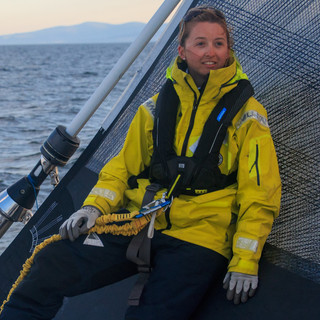
When we departed Cagliari, Italy, in October, we weren’t sure what would happen to our winter training plans. We preemptively put our European set-up back in storage, just in case Lindsay’s injury was worse than anticipated. After returning to the US, it took Lindsay two months to rehabilitate her MCL injury, but with the guidance of the team at NPT Healthworks and an intensive daily rehab program, she was itching to get back to training after Thanksgiving. We had a lot to dig into after our Worlds performance. The thing about pursuing the Olympics is that the list of things to improve never gets shorter, the bullet points just get more specific.

Once cleared to get back on the water, Lindsay and Carson met in Barcelona and took the ferry back across the Med to Sardinia, where many of the Nacra teams decided to stay for the winter. We quickly settled into the same apartment we had for Worlds, making the trip feel a little more homey than usual. The wind in December was remarkably consistent, with a foiling seabreeze every day. This allowed us to grind out reps - take off, transition to H1, take off, transition to H1, take off again. João kept the coach boat tight to leeward to simulate holding the lane off the starting line. It also allowed us to continue testing spars to decide which best suited our sailing style. Sometimes training blocks have huge breakthroughs, but some are just about putting in the work, one brick at a time. December felt like this, but we confirmed that Lindsay’s knee could handle training at full-pace and laid the foundation for skills to work on in the new year. We all flew home for Christmas, leaving the boat snug and secure at the Windsurfing Club.
Lindsay’s gym program over the holidays emphasized cardio and improving agility and dynamic balance. Carson’s included his usual strength routine as well as uphill and downhill skiing, taking advantage of the winter climate to do some cross-training. The work doesn’t stop, even over Christmas!

Upon returning to Europe in January, we were immediately glad to have tied down the boat well, as the island experienced a Mediterranean cyclone days before our arrival. The entirety of the beachfront flooded, with the marina’s gas dock wiping out the Windsurfing Club’s fence and luckily missing the fleet of Nacras. Other than a grubby scumline about 20cm up the hulls, our boat was unscathed, but opening the toolbox revealed a swampy mess. Sadly, Carson’s favorite tool, the battery-powered Dremel, did not survive the storm. It took a few days for the town to recover, working around flooded property and multiple power outages. On top of this, the clouds stuck around, raining often throughout our stay.
One question we get asked is, will you sail in the rain? Yes, yes we will. And we did! The Nacra is a wet boat anyways, so the weather was likely worse for our coaches, who did their best to film and stay warm while chasing us around Cagliari. In January, Maelle Frascari, Italian Nacra 17 World Champion and SailGP strategist, joined us for a dedicated week of maneuvers. We drilled tacks and gybes, with an emphasis on weight placement and footwork for Lindsay and entrance and exit angles for Carson. Maelle was always game to jump in the boat to demonstrate a skill or feel out the settings. She gave us a new perspective on well-tred skills, renewing our focus.
Maelle smiling through the rain Joao and Carson prep a mast for testing Lindsay and Maelle during 'dry'-land training drills
After Maelle left, João joined us again. Unlike December, January provided a mix of conditions, including lighter swelly seabreezes and intense, puffy north-westerlies. The variety let us test sailing styles across the conditions, comparing which settings and intentions worked when. Improvements that were hard to spot in December emerged, particularly in gybes and accelerations. With other teams also practicing nearby, we had a gauge of our progress and our weaknesses, as well as theirs. All of these observations inform our training plans, a valuable asset during the long winter season.
Another bit of inspiration during this block was the Winter Olympic Games, held (in a global perspective) close-by in Milan-Cortina, Italy. While we were busy with training for our own Olympics, it was fun to end a long day chasing our goals by watching the Team USA winter athletes compete for theirs. As usual, we continued to work closely with the Canadian Nacra team, Galen and Maddie, who were cheering for Team Canada just as much as we were cheering for Team USA. Once, Galen walked into a pizza shop to order dinner, saw the Canadian lugers on the TV screen above the register and exclaimed, “CANADA!”, much to the confusion of the cashier, who laughed once Galen explained that he too was a Canadian athlete. It’s a reminder that even across borders, international competition can be friendly rivalry, something that brings us together as we experience the highs and lows of sport.
The highs and lows, the rivalry, and the competition will continue for us at our next event. The 2026 competition season opens at the end of March at the Trofeo Princesa Sofia in Palma de Mallorca, Spain. Time to see how the winter work plays out against the fleet. See you there!

Comments